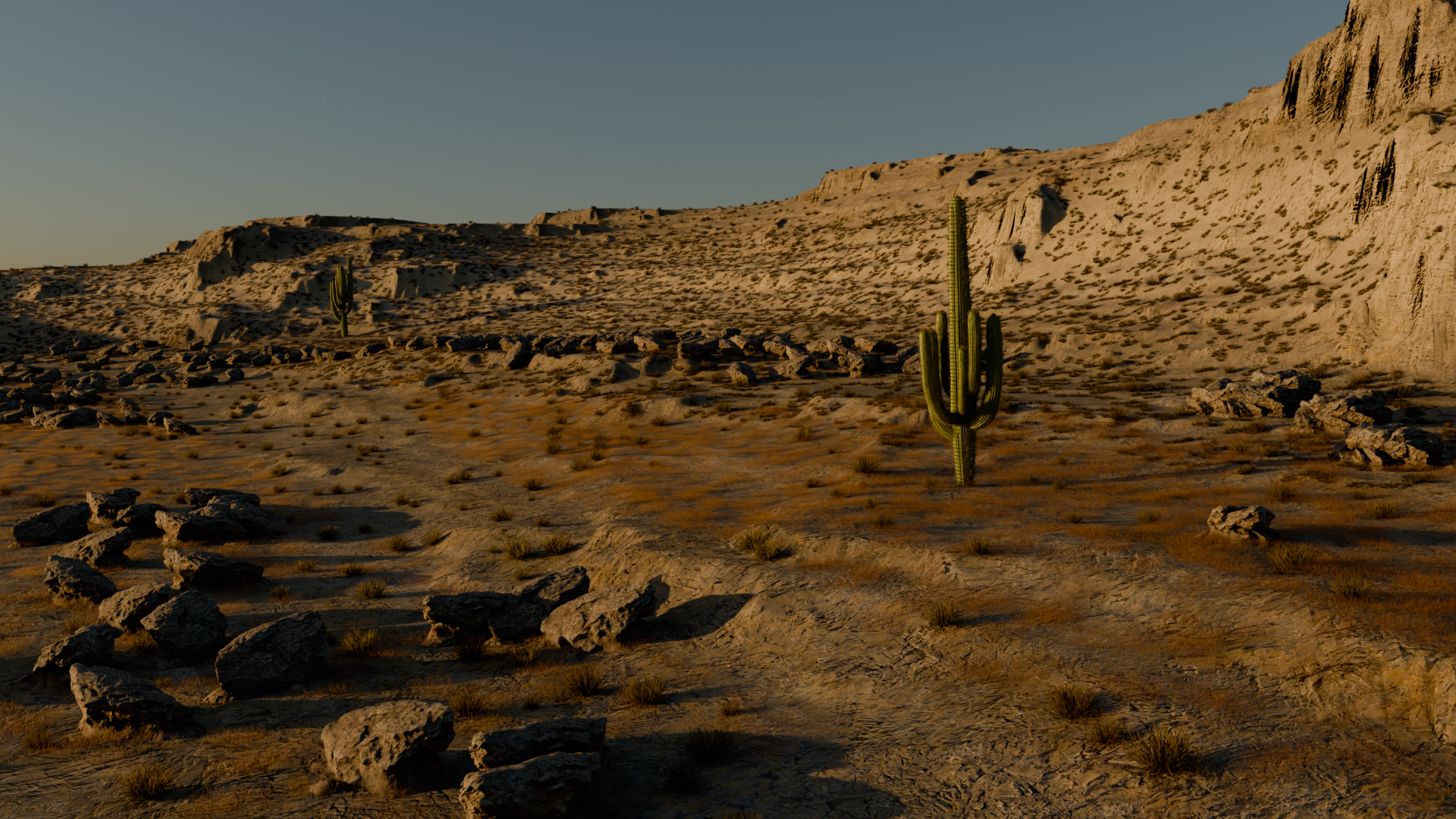
My first foray into Gaea was a success. After thirty minutes of tutorials and toying about, I managed to create my own terrain and export it successfully.
Made in Gaea, rendered in Blender with True-Terrain 5
I'll go back tomorrow for more learning and practice.
I spent some more time playing with True-sky, including creating a new "hero" rock using Rockify. As an add-on, Rockify is a bit of a one-trick pony, but it does its trick really well. This is another use of Physical Open Waters, which is turning out to be pretty amazing.
True-Sky is great. The Fog elements might be better, though
I watched a teaser for Gaea 2.0. Amazed, I was. Cyber Friday upgrade deal, there was.
Gaea 2.0 is due for release in the near year, so this is a free copy of Gaea 1.3 that you get for pre-ordering.
Everyone says how powerful Gaea is for the procedural landscape generation --- World Creator is more sculptural, and I love that you have that hands-on control, but sometimes you want the process to drive the detailing. Gaea is mostly graph-based. You drop in nodes to set up a series of actions. It's not as satisfying, but the results can speak for themselves.
So, this morning is Gaea 101. I'm hoping to have an exported height map made before too long.
Another day, another True-Terrain 5 test. This time, the challenge is a small but highly detailed scene. The land is just 100m x 100m- tiny! However, the resolution is ramped up to create about 16 million vertices.
I struggled to get rid of the noise, but in the end, I created a render that is intentionally suboptimal with the atmospherics and glare, so it sort of holds together.
Viewport without the scatter objects
Viewport solid mode
In other news, I ordered a Wacom tablet. It should come tomorrow. It will help with sculpting and painting.
I bought something. Again. Black Friday! Grassblade. A vast collection of grass-related assets, along with scatters and a small add-on to apply them, although you can also add them via Geo Scatter.
Fireflies! Well, this is probably the result of me throwing too much into the scene without planning. The base render featured lots of annoying white pixels, which denoising turned into delicate but distracting light smudges.
The earlier iteration without True-Sky's lovely Alien atmospherics -- which may have partly caused the firefly attack.
The base terrain, created in True-Terrain 5. I'm getting to grips with more of the features.
A terrain that I created using TT5's noise system. True Sky brings so much to the table.
Some crashes, but on the whole everything is stable, and I've created some massive scenes without issue. Most crashes have been caused by UI interactions rather than in the render pipeline.
I'm still generating most of my topology using World Creator 2023. It is still the king of natural landforms.
True Terrain 5 has its own erosion system. I had a play. It's going to take some practice and a little more documentation before I can use it effectively. It's very promising, though!
I've delved deeper into the mud and rock of True Terrain 5. I've had some crashes, mostly random, but the overall experience has been very positive. Good performance, mostly.
The terrain editing is really flexible, although World Creator 2023 makes it easier to generate complex natural-looking erosion and landforms. That said, most of these examples incorporate some TT5 noise-based elements.
This looks up to the same very high standard. Physically based for great realism.
BagaStreet
A second brilliant add-on. This one from antoine-bagattini, the creator of Bagapie. It's a big library of street furniture. Perfect for any arch vis work, integrated into Bagapie's tool kit for great scatter and placement tools.
I love TT5, although we have yet to see the scattering functionality. Terrain generation is really flexible and I don't think I'd ever go back to 4, even though version 5 is still in early development.
My trusty old low-poly Assets scattered with Geo-Scatter 5.3
True Terrain 5 is a terrain creation tool for Blender 4. It retains the basic concepts of True Terrain 4 but uses a brand-new application platform that offers more power and flexibility than an incremental update of True Terrain 4 could have provided. The most significant change is the move to a Photoshop-style layer-based system that unlocks terrain creation compared to the somewhat baked-in limits of version 4.
Today, I played with the built-in terrain system. I've been exclusively using my height maps from World Creator 2023. Given the extensive terrain editing options, I decided to have a go at creating my own terrain. It works pretty well, although you need to call on a lot of advanced knowledge to make realistic land forms. I didn't get into the erosion system, which probably helps make things look like they are possible in the real world.
True Terrain 5 is really stable, and I slipped into silly territory and exceeded my GPU's VRAM, which takes some doing, given my RTX 4090 has 24GB. It would be good to have a review process to recognise when a set of parameters will cause the system problems. Geo-Scatter does a great job at this.